
.png?width=243&height=47&name=logo_caser%20(2).png "logo_caser (2)")

May 14, 2026

Caser Expat Insurance
Sales
Customer Care
As you settle into your new life in Spain, having a car often becomes an essential part of the journey. Whether you’re living outside major metropolitan areas, commuting regularly, starting a new family or simply yearning for the freedom to explore the country, driving quickly becomes more than just a convenience.
While some expats rely on rental cars, others decide to buy their own. In both cases, the rules are the same: when driving in Spain, you must carry specific documentation and safety equipment in your vehicle.
Spanish traffic authorities carry out regular roadside checks, and if something is missing or not valid, fines may apply. To ensure your journeys remain peaceful and lawful, this driving in Spain checklist: documents & equipment outlines everything you need to carry in your vehicle, alongside the latest regulatory changes every expat must be aware of.
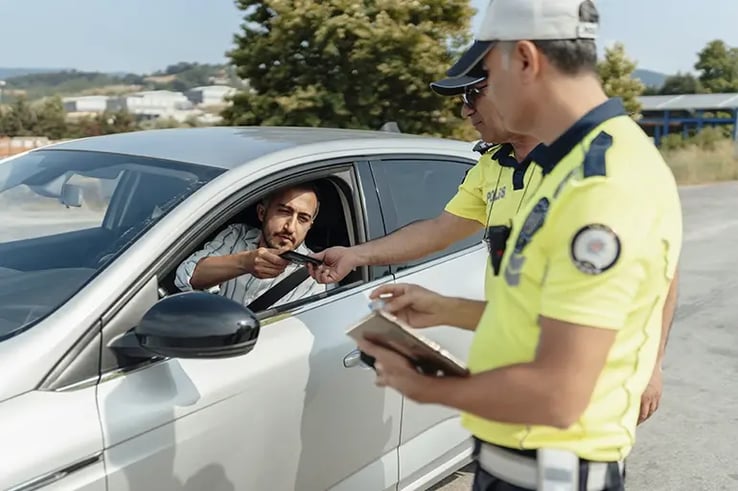
Before starting the engine, the first thing to check is paperwork. In Spain, drivers are required to carry original documents, not copies, unless they are officially certified.
When driving, you must carry the following:
If any of these documents are lost or stolen, you must report the incident at the nearest police station and then request a replacement from the Dirección General de Tráfico (DGT). In the meantime, you can still drive, and if a policeman asks you for the documents, you just need to show proof of having filed a report.

To protect yourself and other drivers in case of accident or breakdown, Spanish law requires specific safety items to be always carried in the vehicle. For this reason, every expat’s “driving in Spain checklist: documents & equipment” must also include:
This is perhaps the most important update for any expat driver. Until now, the law required two reflective warning triangles. However, to improve safety and prevent further accidents while walking on the road, this regulation has changed.
As of 1 January 2026, the V16 connected warning beacon has officially replaced the triangles as the mandatory signalling device in case of an accident or breakdown.
This magnetic device is placed on the roof of the car without the driver needing to exit the vehicle. It emits a high-intensity flash and sends your coordinates to the official authorities alerting emergency services and other drivers near your location.
Being able to geolocate your vehicle in case of accident is crucial. Imagine you are driving on a remote road or at night and an accident happens, getting in touch with the emergency services or explaining your location might not be easy. To address this, Caser Expat Auto Insurance now includes Caser Autohelp in all its policies.
This service acts as an invisible safety net. It activates automatically when your vehicle is in motion, and only triggers if an accident is detected. The system then contacts you immediately and, if no response is received, it alerts the emergency services with your exact location.
It is designed with privacy in mind, meaning there is no continuous tracking, as your location is only accessed in the event of an accident.
Some documents are no longer mandatory because authorities can check them digitally. However, carrying the physical document can still be useful in certain situations, such as technical issues during a roadside check. These documents include:
Bear in mind that, although carrying the physical document is not required, having valid insurance is mandatory for driving in Spain and all vehicles must be covered by, at least, third-party liability insurance. If you are new to Auto Insurance in Spain and want to learn more about how it works and what affects the price you pay, you can access our latest guide.
Navigating insurance in a foreign country may involve unique challenges. For expats, factors such as residency status, the transition from a foreign driving license or merely different driving habits can complicate standard insurance applications.
Caser Expat Auto Insurance is designed to bridge this gap.
It provides a wide range of coverage options, from basic third-party to comprehensive all-risk policies, that are tailored to the expat community. This ensures that you are not only legally compliant but also protected by a service that understands your specific background and provides assistance in a language you are comfortable with.
Driving in Spain becomes much easier when you know exactly what is expected of you. Carrying the right documents, having the mandatory safety equipment in your car and being informed about current regulations helps avoid unnecessary complications on the road.
Choosing the right insurance is also part of that preparation. Having cover that adapts to your situation and services designed to support you when you need help, allows you to focus on what matters most: driving calmly and enjoying your time in Spain.
If you want to compare options and find coverage that suits your needs, you can easily calculate your Auto Insurance quote.
|
If you are searching for car insurance in Spain, Caser Expat Insurance has the right policy for you! |





Let Us Know What You Thought about this Post.
Put your Comment Below.